



Table of Contents
GivingTuesday 2026 falls on Tuesday, December 1. The best GivingTuesday social posts pair a specific ask with a real deadline, not a polished graphic. GivingTuesday’s own 2026 guidance to nonprofits says exactly that: prioritize authentic photos and video over designed templates.
That’s a useful, if inconvenient, thing to hear from the organization that runs the day. Most GivingTuesday social guides hand you a stack of generic graphics instead. This one gives you something more useful: twelve captions, organized by posting time, plus what’s actually changed on each platform since last year.
Key Takeaways
- Plan six posting stages, not scattered one-offs: save-the-date, countdown, day-of, and Thank-You Wednesday (Dec 2), a stage most guides still skip.
- The platform mix has shifted: X nonprofit adoption fell from 59% to 22%, while TikTok now leads on engagement. Redirect effort accordingly.
- Retire #GivingTuesdayNow, and double-check Facebook’s and Instagram’s current donation-tool fees and eligibility before you promise a “tap to give” option.
- Social earns the click; pair it with email, text, or a call to close the donors who see the post but don’t convert same-day.
Why the graphic matters less than the words
A well-designed template still helps, but it doesn’t make someone stop scrolling. The caption does that. A specific number, a real deadline, or a name does more work than a stock GivingTuesday badge ever will.
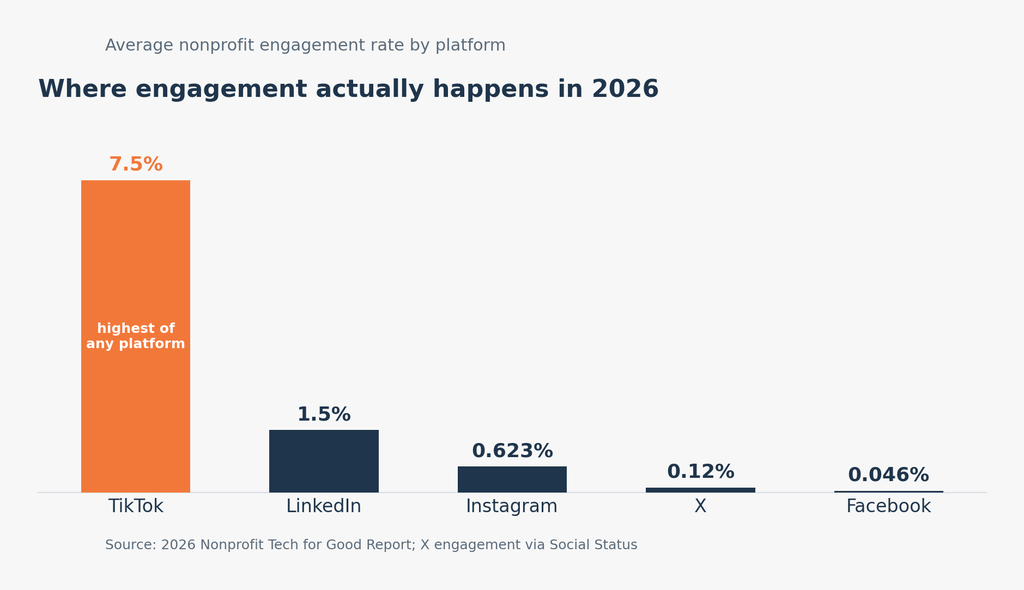
That’s also why authenticity keeps winning on the platforms with the best engagement. Instagram’s engagement rate for nonprofits sits at 0.623%, the highest of any traditional platform, and it’s built almost entirely on Stories and Reels, not feed graphics. Keep that in mind as you read the captions below: swap in a real photo or a ten-second clip before you reach for a template.
Where engagement actually happens in 2026.
Read Also: GivingTuesday Fundraising Ideas for Nonprofits
The GivingTuesday posting calendar
Posting once on December 1 and hoping it lands is the most common GivingTuesday social mistake. A real campaign runs across six moments, each with a different job. They line up one-to-one with a matching GivingTuesday email sequence.
| Stage | Timing | Job |
|---|---|---|
| 1. Save the date | 30-15 days before | Get December 1 on people’s calendars |
| 2. Build the countdown | 15-7 days before | Set the goal, build anticipation |
| 3. Final week | 7-2 days before | Add urgency, make the ask concrete |
| 4. One day out | The day before | Last reminder before the day itself |
| 5. GivingTuesday | December 1 | The ask, a midday update, and an evening push |
| 6. Thank-You Wednesday | December 2 | Close the loop and show the result |
That last stage is worth calling out. GivingTuesday’s own toolkit suggests #ThankYouWednesday for December 2 posts thanking donors and sharing results.
1. Save the date (30-15 days before)
Get the date in front of people early, without asking for anything yet.
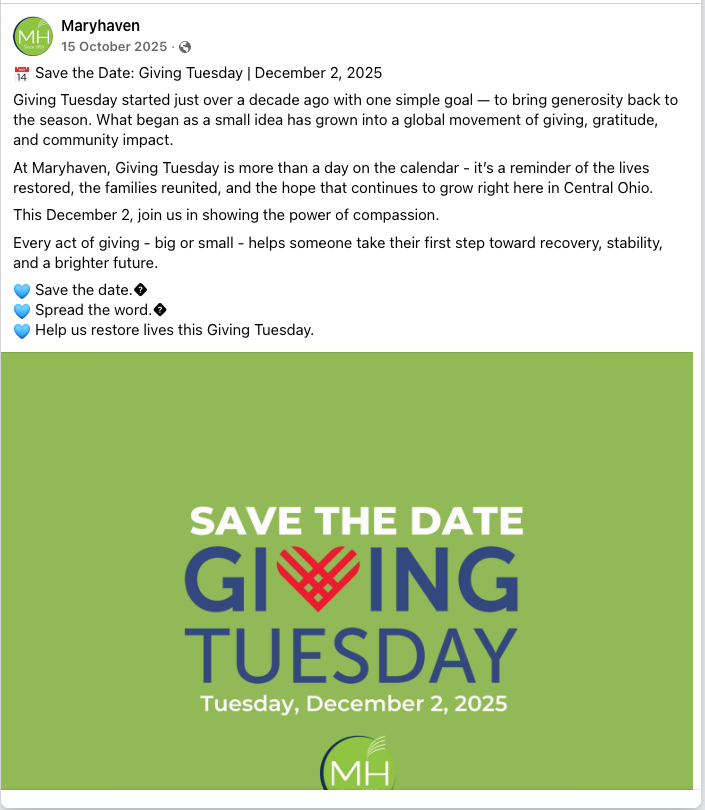
Mark your calendar: GivingTuesday is Tuesday, December 1. This year we’re raising funds for [specific program], because [specific need]. More details soon. [link]
GivingTuesday is three weeks out. Last year, gifts like yours helped us [specific 2025 result]. We’re back at it December 1. Follow along here: [link]
Source: Maryhaven
2. Build the countdown (15-7 days before)
Set a real goal and start naming what specific gift amounts fund.
10 days until GivingTuesday. Our goal this year: $[amount] for [specific program]. Here’s what $25, $50, and $100 each fund: [breakdown]. [link]
One week from today, we’re asking our community to show up for [cause]. If your employer matches gifts, now’s the time to check, most donors never do. [link]
3. Final week (7-2 days before)
This is where urgency belongs, tied to a real number, not a countdown clock for its own sake.
GivingTuesday is [X] days away. We’re $[amount] from our goal, and every gift between now and December 1 gets us closer. [link]
A reminder before Tuesday: [specific impact stat, e.g. “a $50 gift funds one week of meals”]. Save this post so it’s easy to find on the day. [link]
4. One day out (the day before)
Make the day’s plan visible so people know when to show up.
Tomorrow is GivingTuesday. We’re opening the day at [time] with [specific plan: a livestream, a matching window, a goal reveal]. See you there. [link]
One more sleep until GivingTuesday. If you’re planning to give, here’s exactly what your gift funds: [specific breakdown]. [link]
5. GivingTuesday (December 1)
Post at least twice: a morning ask and an evening push. A midday update is a strong third if you have the capacity. Send the same updates by text too. These Giving Tuesday text message scripts are ready to copy.
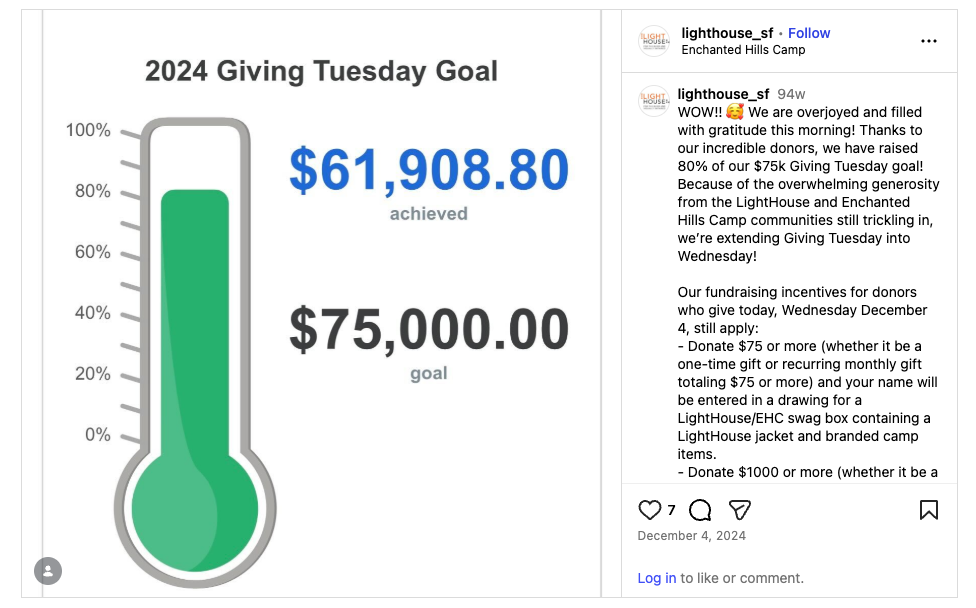
It’s GivingTuesday. Today, every gift toward our $[goal] goal helps [specific impact]. Give now: [link]
A few hours left on GivingTuesday. We’re $[amount] from our $[goal] goal. Help us close it out before midnight: [link]
Source: lighthouse_sf
6. Thank-You Wednesday (December 2)
Close the loop while the campaign is still fresh. GivingTuesday donors retain well: 65% give the following year again, compared with 52% overall, according to GivingTuesday’s donor retention research with Blackbaud Institute. A thank-you post the same week helps earn that.
Thank you. Because of gifts like yours, we raised $[total] this GivingTuesday, [X]% more than last year. Here’s what happens next: [specific outcome]. #ThankYouWednesday
It’s Thank-You Wednesday. Yesterday, [X] people gave to [cause]. If that was you, thank you. Here’s the impact you’re now part of: [link]. #ThankYouWednesday

Source: rfumslife
Read Also: GivingTuesday Thank-You Guide
What’s changed on each platform since last GivingTuesday
Nonprofit adoption and platform tools both shifted meaningfully over the past two years. Figures below are from the 2026 Nonprofit Tech for Good Report unless otherwise noted.
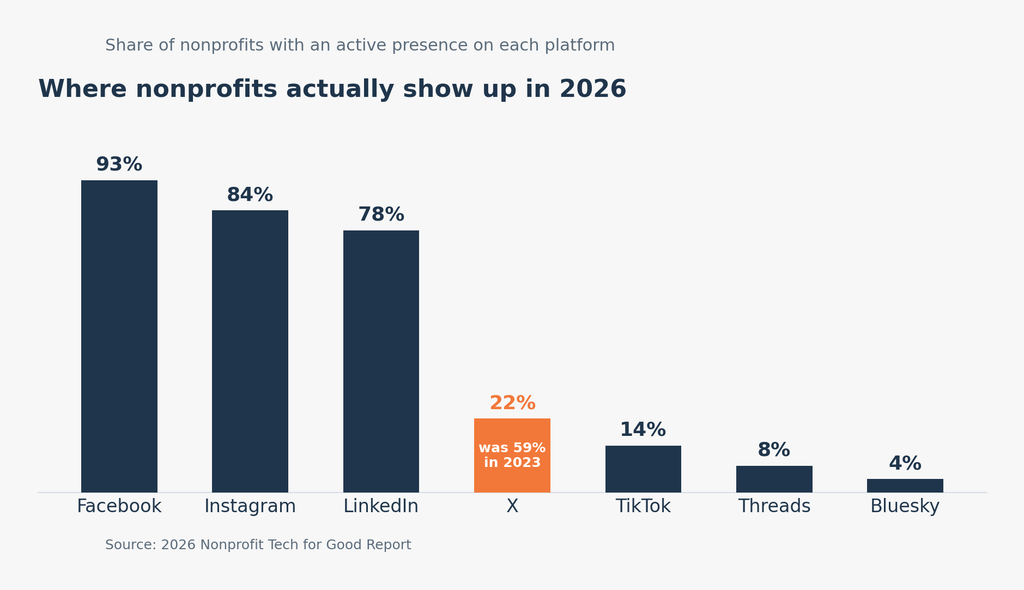
Facebook. Still nearly universal (93% of nonprofits use Facebook Pages, down slightly from 96% in 2023), but engagement is the weakest of the major platforms at 0.046%. The donate button and personal or birthday fundraisers still work, but Meta now routes most donations through PayPal Giving Fund in the US, UK, Canada, and Australia, which charges nonprofits roughly 1.99% plus $0.49 per gift, a cost Meta used to absorb. Recurring donations are no longer available through Meta’s native tool, and support for nonprofits in the EEA ended in mid-2024. Use Facebook for reach and livestreaming; don’t count on it as your primary donation mechanism.
Instagram. Adoption has nearly doubled since 2023, from 49% to 84% of nonprofits, and engagement leads every platform measured at 0.623%. The donation sticker is available in Stories, but only for organizations registered as a 501(c)(3) in the US. Lead with Stories and Reels here, not feed graphics.
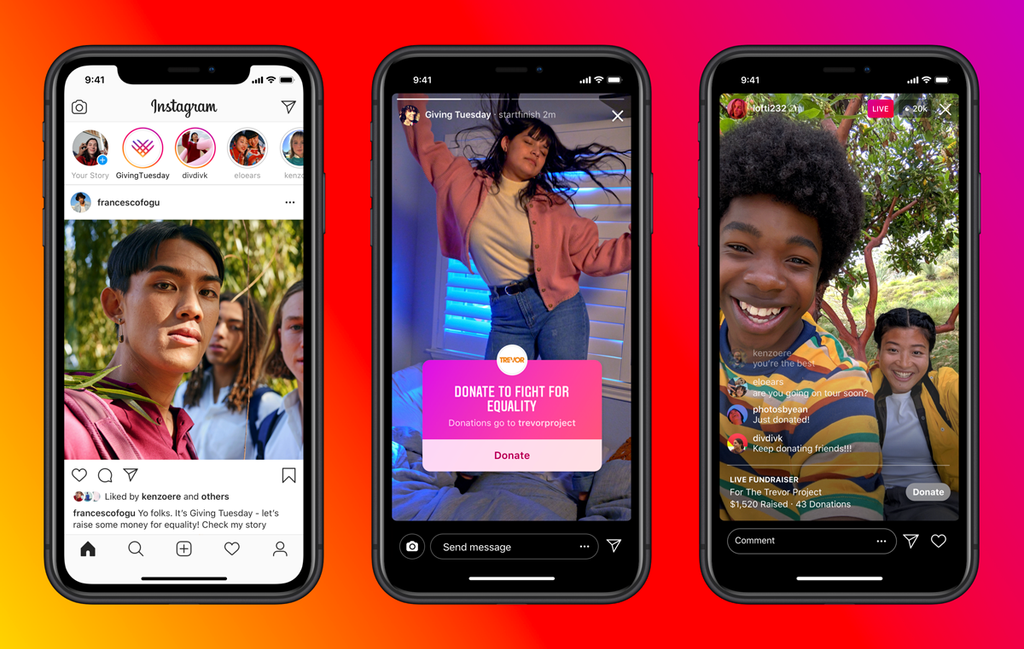
Source: Instagram
X (formerly Twitter). Adoption has collapsed, from 59% of nonprofits in 2023 down to 22% in 2026, and 13% of the nonprofits still posting there say they’re considering leaving. Engagement is the lowest of any platform in this list at 0.12%. If your organization still posts here, keep it minimal: one to two hashtags, a link, nothing more elaborate. This isn’t the platform to invest new GivingTuesday production time into.
LinkedIn. Adoption jumped from 49% to 78% of nonprofits since 2023, and engagement is strongest among traditional platforms at 1.5%. It’s also where a matching-gift ask lands best: your corporate donors and their HR teams are more likely to see it here than anywhere else.
TikTok. Only 14% of nonprofits use it, but engagement is the highest of any platform, measured at 7.5%. If your organization already has a presence, a short, unpolished clip (a staff member explaining the ask on camera) will outperform a produced graphic by a wide margin.
Threads and Bluesky. Adoption is still small: 8% of nonprofits on Threads, 4% on Bluesky, so neither is worth a dedicated GivingTuesday strategy this year. If your organization already posts on either, cross-post your Instagram captions rather than building platform-specific content.
YouTube. Adoption data specific to GivingTuesday isn’t clean enough to cite here, but the practical move is the same as elsewhere: livestream your GivingTuesday event or a thank-you segment, then pin the donation link in the description and the top comment. Don’t spend time chasing a native donate button; YouTube’s isn’t built for a one-day campaign the way Instagram’s or Facebook’s is.
Read Also: GivingTuesday Toolkit for Nonprofits
Which GivingTuesday hashtags actually work
Keep this short. GivingTuesday hashtags don’t need a long list; they need the right two or three.
- #GivingTuesday. The only one that matters at scale. GivingTuesday.org’s own toolkit asks nonprofits to include it specifically so the organization can retweet and share campaign posts.
- #ThankYouWednesday. GivingTuesday’s own suggested tag for December 2 posts. Genuinely underused; none of the competing pages reviewed for this refresh mention it.
- Two or three mission-specific or location tags, maximum. Something like #AnimalRescue or #YourCityGives, if it’s genuinely relevant. More than that reads as noise and does nothing for reach.
Drop #GivingTuesdayNow entirely. It was a one-off emergency fundraising day held in May 2020, in response to COVID-19, not a recurring GivingTuesday hashtag. Using it in December still shows up on a few older guides (the live page’s hashtag list included it), and it’s actively misleading advice in 2026.
Free assets, before you design anything
GivingTuesday.org publishes open-source logos and art files nonprofits can customize freely, along with a peer-to-peer fundraising toolkit and a sample press release template. Start there before commissioning new graphics. It also covers the “giving tuesday images” search intent better than a stock badge would: the assets are official, free, and already sized for social.
Read the full GivingTuesday toolkit next
Twelve captions cover one channel. A real GivingTuesday campaign runs social alongside email, text, and calls, plus the planning and assets that tie all four together. The GivingTuesday Toolkit for Nonprofits is where the rest of that lives: a full campaign checklist and timeline, with links to the rest of this cluster (emails, subject lines, scripts, thank-you messaging), so you’re not hunting five other pages down one at a time.
Read the GivingTuesday toolkit
If you’re coordinating GivingTuesday across social, email, text, and calling instead of running each one separately, book a demo to see how CallHub keeps it in one place.
FAQs on Giving Tuesday social media posts
When is GivingTuesday 2026?
GivingTuesday 2026 is Tuesday, December 1, 2026, the Tuesday after Thanksgiving (Thursday, November 26).
What hashtags should I use for GivingTuesday?
#GivingTuesday is the one that matters at scale. Add #ThankYouWednesday for December 2 posts, and no more than two or three mission-specific or location tags. Skip #GivingTuesdayNow, it’s a 2020 COVID-era one-off, not a recurring GivingTuesday tag.
How many times should I post on GivingTuesday?
Plan for posts across all six stages of the calendar above, not just a single post on the day. On GivingTuesday itself, two posts is the minimum: a morning ask and an evening push. A midday update is a strong third if your team has the capacity.
Is Facebook’s donate button still free for nonprofits?
Not entirely. Meta now routes most US, UK, Canadian, and Australian donations through PayPal Giving Fund, which charges nonprofits roughly 1.99% plus $0.49 per gift, a fee Meta previously covered itself.
Does Instagram’s donation sticker work for any nonprofit?
Only organizations registered as a 501(c)(3) in the United States can use it. Confirm eligibility before building a campaign around it.
Should my nonprofit post on Threads or Bluesky for GivingTuesday?
Not as a dedicated strategy yet. Adoption is still small, 8% of nonprofits on Threads and 4% on Bluesky, so cross-posting your Instagram captions there is enough for 2026.